The May 13, 1884 letter from Jefferson Davis to my great, great-grandfather, Col.W.R. Stuart, archived in the digital collection at Miami University.
There seems no end to the documentation of my great, great-grandfather’s life. Like they say at Disney World, it is a small world after all and my ancestor, Col. W. R. Stuart seems to have run across every person in it. Above is a letter written to him by the one and only president of the Confederate States of America, Jefferson Davis, part of the Samuel Richey Collection of the Southern Confederacy at Miami University. Stuart was a Confederate like Davis, but the 1884 letter is a different kind of business. Davis was trying to buy a ram from the Colonel who raised them along with pecans. My cousin, Monique found the letter through a Google search while trying to find images of the Colonel’s company logo.
It would be nice to find as much information about my enslaved ancestors as I do about the people who owned them like the Colonel. I’ll keep trying. Meanwhile, as a kind of beacon of hope, I offer up the following picture of the masthead of an 1860 edition of the anti-slavery newspaper, “The Liberator.” It was given to me by my friend, Dave Pettee who I met through Coming to the Table, an organization that brings together descendants of slaves and slave holders to heal the legacy of slavery.
June 8, 1860 edition of William Lloyd Garrison's abolitionist newspaper, "The Liberator."
Promotional picture for the 1998 documentary, "The Language You Cry In."
On Saturday, I shook off the magic dust of a week at Disney World and got back into my real life by attending the monthly meeting of my local African American Genealogy Society. Our group leader had print outs of the 1940 federal census on hand so we could all get a close up view of the details included in that 72 year-old document. Much more intricate than the ones we fill out now, the 1940 census can reveal a lot about an ancestor. She also brought along a documentary called, “The Language You Cry In.” It’s the remarkable story of how a song passed down by the women of a Gullah family in Georgia is traced back to Sierra Leone. Through a song, this American family found its roots in Africa.
I broke down in tears more than once during the viewing. Not only was it remarkable that 200 years of lost history was reclaimed through a song that a grandma sang while doing chores and playing with her offspring, but it was also inspirational. It gave me hope that I too might find where in Africa my ancestors come from.
I know I could find out by just taking a DNA test already and be done with it. And I have. But I haven’t looked at the results yet. I’m still hoping to dig up my history by what my ancestors left behind, like my grandpa’s story that got me started on this journey, my great-grandmother Josephine’s newspaper articles that make me think that writing is in my genes, and great, great-grandma Tempe’s ads looking to reunite with her family after slavery ended – another inherited trait – the need to find my people. I still have hope that some piece of paper or some story will emerge that connects me to the African country we came from.
So, I will refrain from the magic of DNA for at least another week while I follow up with a few other leads on my African ancestry. I’ll keep you posted.
Meanwhile, if you’re looking for leads to your African ancestry, make sure you check out Sharon Morgan’s website, Our Black Ancestry which has tons of links to resources. And if your people are from Virginia, check out the Virginia Historical Society’s Unknown No Longer project which my friend LaKesha Kimbrough brought to my attention.
Tonight, I’m joining Joe McGill and several others in a sleep-in to preserve history at the Greenwich Historical Society in Greenwich, CT.
A Civil War re-enactor and program officer of the National Trust for Historic Preservation, McGill has slept in 29 slave dwellings in the past two years as part of his mission to preserve these mostly decaying and forgotten monuments of American history. Most recently, he slept in a cabin at Friendfield Plantation in South Carolina where first lady Michelle Obama’s great-great grandfather was enslaved. Tonight will be his second time sleeping in a slave dwelling in the North. He’ll sleep in a dwelling in the attic of the historic Bush Holley house, home of the Greenwich Historic Society.Guests have sometimes joined him in his preservation sleepovers, some descendants of slaves like himself, some white. But none ever claimed their intimate connection to the experience as a descendant of a slave owner until now.
Grant Heyter-Menzes, a biographer from Canada will join McGill sleeping inside the cabin. Both Grant’s southern and northern ancestors held slaves. His ancestor, Nathaniel Lynde, who had four slaves, donated the land where Yale University stands today.
I met both men through Coming to the Table, an organization that brings together the descendants of slaves and slave owners to heal from slavery’s historical harms. I’ll be joining them and another CTTT member, Dave Pettee in a panel discussion before the sleep-in.
Check out Joe McGill’s slave dwelling schedule. And if you’d like to sleep-in to save history, send him a note. I’m sure he’d like the company.
This time last year, five generations of my family celebrated my grandmother's 95th birthday. My grandma, Louise Walton, is seated in the center. She turned 96 on Monday. My daughter, Devany, seated in the front on the right is nine today. Happy birthday to both birthday girls!
Me at Libby Hill Park in Richmond, VA. where the view is said to so closely resemble that of Richmond on the Thames in England that it gave the city its name. Along with a great view, the park boasts an enormous Confederate monument. Photo courtesy of Jane Feldman.
The above picture was taken this weekend in Richmond, Va where I joined people from all over the country to participate in the first national gathering of Coming to the Table. CTTT is an organization that aims to address and heal the historical harms of slavery by bringing together the descendants of slaves and slave owners and, through our personal narratives, tell a more complete story of our country’s history. To get to historic Libby Hill Park overlooking the James River from the Richmond Hill retreat center where we were staying, our group of roughly 70 had to walk past the church where Patrick Henry famously proclaimed, “Give Me Liberty or give me death,” never minding that he owned slaves. We had to stand in the shadow of a monolithic statue of a Confederate Soldier that towered above us while we listened to the story of the city’s past.
The plaque that I’m leaning on explains how Richmond may have gotten its name. But what the plaque doesn’t say is that the area had belonged to Native Americans for thousands of years when Europeans arrived and that it was once the largest slave trading post outside of New Orleans. Before photographer Jane Feldman took this picture, our CTTT friends, the children of slaves, masters, and sometimes both, gathered for a healing ritual at this site. Could there be a more perfect place for us to acknowledge our complicated connection to each other as the descendants of both slaves and slave owners and try in some small personal way to heal the strain of that legacy while clasping hands, and calling the names of our ancestors out into the middle of our circle?
As a memento of our time together, CTTT member Chandler Dennis distributed a brilliant bumper sticker that read, “Creating Peace, One Cousin at a time.” (Whether we’re actually blood relatives or not, CTTT members often call each other cousins, because, in the big picture, we’re all related.) I’d like to think that more specifically, we’re reclaiming our history, one cousin at a time.
So, after our momentous weekend together, I’m motivated to spread the word and invite more people to the table. Bring your cousins.
My CTTT cousins and me at the Confederate Monument in Richmond, VA.
In his historic speech given at the march on Washington, Dr. Martin Luther King, Jr. said that one day, “the sons of former slaves and the sons of former slave owners will be able to sit down together at the table of brotherhood.”
Tomorrow, I’ll be traveling to Richmond, VA for the first national gathering of Coming to the Table, an organization inspired by King’s vision. I’ll be among about 70 descendants of slaves and slave owners from all parts of the country coming together at that table of brotherhood from March 16th through the 18th.
Coming to the Table is an organization that aims to acknowledge and heal wounds of racism rooted in the US’s history of slavery.
Finding and becoming a part of this organization is one of the many unexpected perks of researching my family’s history. All I really wanted to do when I set out on this journey was to discover what happened to my great-grandmother, Josephine, the daughter of a slave and master. I didn’t bank on making new friends with my far flung family members or allies in the descendants of the people who used to own my kin. And I certainly had no lofty goal of joining a group that wanted to heal the wounds of slavery. But I’m doing all three. Who says genealogy can’t be life-changing?
What unexpected bonuses have you received from researching your family’s history?
Delaware regiment fighting in the Battle of Long Island during the American Revolution in August, 1776. My fourth great-grandfather, Dr. Alexander Stuart fought in this conflict. (Picture courtesy of Creative Commons)
Celebrities in this season’s latest installment of Who Do You Think You Are? aren’t the only ones getting genealogy gems. Thanks to the show’s sponsor, ancestry.com and my cousin Monique, who seems to find our far-flung relatives as easily as I breath, this week, I met, via email two new cousins from my Stuart line.
Not only did cousins Ginny and Anne come to our virtual family table with great information, like the fabulous but false family legend that our ancestor, Dr. Alexander Stuart was George Washington’s physician. They also connected me with a picture of that same ancestor. The sketch of ” Col Alexander. Stuart / of Washington’s Army” as once labeled on the painting is archived at the Baltimore Museum of Art and attributed to French portraitist, Charles Balthazar Julien Févret de Saint-Mémin (1770–1852) . Saint-Mémin fled France during the revolution, and worked as a portrait engraver in the United States creating portraits of George Washington and Thomas Jefferson among other luminaries.
Dr. Alexander Stuart was my fourth great-grandfather and, according to his son’s obituary, he did fight in the Revolutionary War. He was in the Battle of Long Island, my new cousins say, and was taken prisoner by the British. As a member of the Delaware Continental line, Dr. Stuart would have been in Washington’s Army, but no evidence suggests that he was the “old general’s” doctor.
But then again, there was no evidence supporting my grandfather’s story that his grandparents were a slave and her master until I went looking for it and found it with the help of my distant cousin and a team of virtual friends. So, I guess I’ve got some new hunting to do.
I’ll be starting with the published Delaware State Archives’ volume on military matters which my new cousins say well document our ancestor’s Revolutionary War Service.
I wonder if Princeton University will give me some kind of honorary degree for all of the hours I’ve been logging in their microfilm library.
In the past two weeks, I’ve been down there three times. (No easy feat with two kids, boxes that still need unpacking from our move and the two hour long round trip drive).
But I had to do it.
Amongst the vast records archived at Princeton’s Firestone library is a microfilm copy of the The Stirling Family papers. The Stirlings had at least three plantations in Attakapas, Louisiana which encompasses St. Martin and St. Mary parishes. They owned at least 100 slaves including my third great grandmother, Eliza Burton and some of her children. I keep returning there in hopes of finding any mention of Eliza or her family.
On my last visit, looking through the last of the five microfilm devoted to their papers, I came to the best part of the documents – the Register of Slaves. When I say best, I mean the part that holds the most promise. Emotionally, this discovery is close to the the worst part of the papers. The register shows that some of the slaves died as infants. Almost none are listed with last names. But sometimes, both the mother and father of the child are listed. Reading the register is like walking through an emotional minefield. One must proceed slowly and with caution.
But read I must. The Stirling’s meticulous record keeping of the births of their slaves could help me recover my ancestors. While an Eliza is mentioned, as well as a Tempe, Eliza’s daughter, I don’t think they are my Eliza and Tempe. The ages of these slaves would make them too young to be my people. But perhaps they’re your Eliza and Tempe. Once I figure out how to upload this 22 page file, you can check the register of slaves by clicking on the tab, “Enslaved People of Louisiana.” In the meanwhile, just shoot me an email if you want to look for your ancestors in the register and I’ll email you a copy.
I still have about a half a microfilm left to go so, after I catch my breath again from my own life and that of my ancestors, I’ll go back down to Princeton in hopes of reclaiming my people and maybe yours as well.
Peter Rene Monrose 1917-2011. He met my great, great-grandmother, Tempy Burton, when he was a little boy.
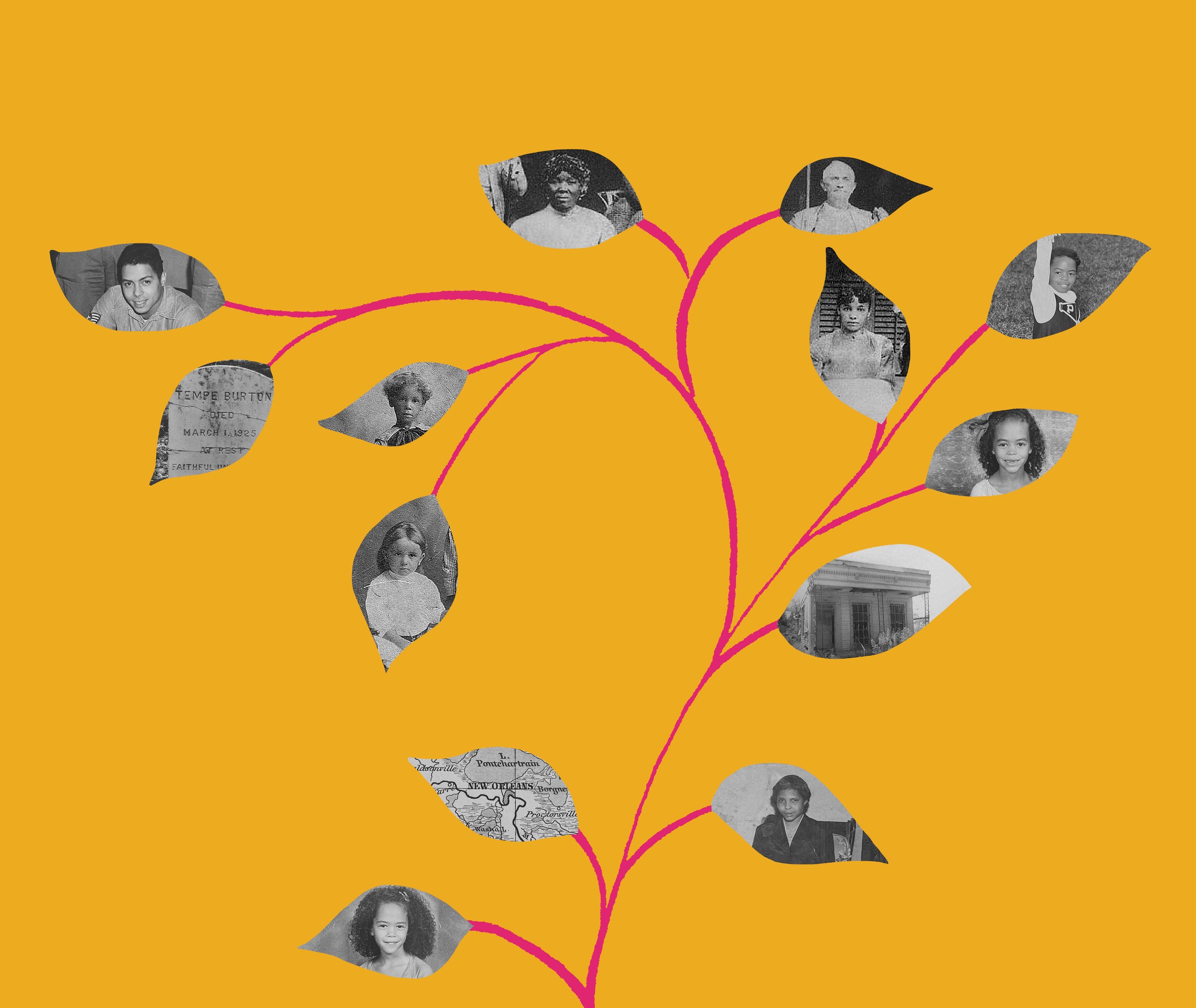
If ever I had a top 10 list of genealogy moments, speaking to Peter Monrose would be right up there along with finding the picture of my ancestors pictured in the header of this blog and the newspaper ad my great, great grandmother Tempy Burton wrote looking for her family whom she’d been separated from through slavery. When he was a little boy, Peter Monrose met Tempy Burton. He said he didn’t remember much about Tempy except that she was very old (probably nearing 100) and that he’d heard that her son had been lynched in the bayou near where she lived in Ocean Springs, Mississippi. In our brief telephone exchange, I felt like I’d reached out and touched my great, great-grandmother via his memories. From his distant recollection almost a century later, I was able to find a newspaper article that seems to corroborate the rumor of the lynching. While all knowledge about my ancestors is welcome, that discovery was bittersweet just like my connection to Peter Monrose. His distant cousin Elizabeth McCauley Stuart owned my great-great grandmother Tempy. We’re linked through slavery.
One of the things that has happened to me on this journey of researching my ancestors is that my idea of family has expanded. On the phone, he called my great, great-grandmother Aunt Tempy. Now, in grateful acknowledgement of the treasure of his shared stories, I can’t help but call him Uncle Peter.
He passed away in December. May he rest in peace.
Peter Rene Monrose 1917-2011
The photos are courtesy of Peter’s daughter, Renée Monrose.